Excerpts from Jacob Riis, How the Other Half Lives
(skim this first for a bit of context: How the Other Half Lives)
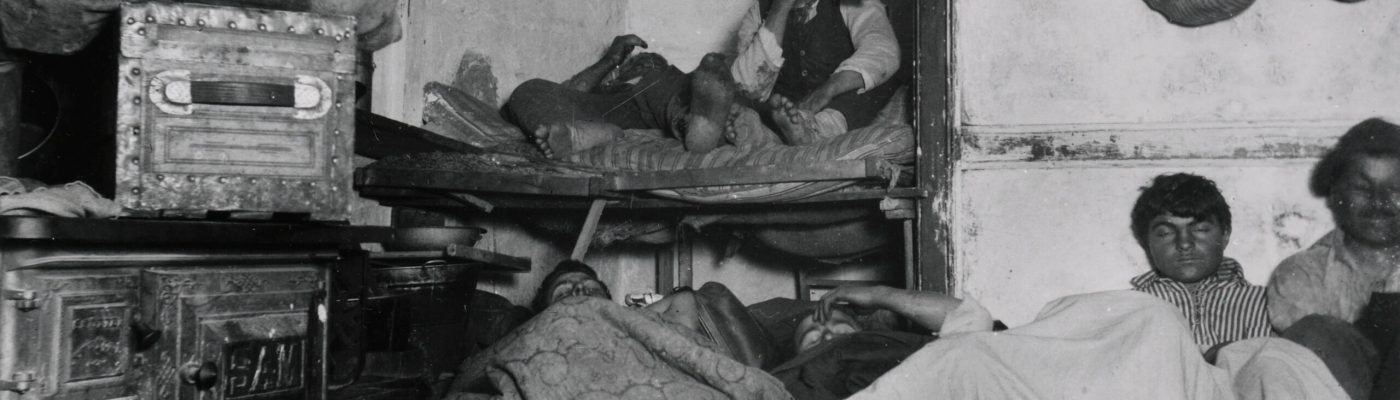
The dread of advancing cholera, with the guilty knowledge of the harvest field that awaited the plague in New York’s slums, pricked the conscience of the community into action soon after the close of the war. A citizens’ movement resulted in the organization of a Board of Health and the adoption of the “Tenement-House Act” of 1867, the first step toward remedial legislation. A thorough canvass of the tenements had been begun already in the previous year; but the cholera first, and next a scourge of small-pox, delayed the work, while emphasizing the need of it, so that it was 1869 before it got fairly under way and began to tell. The dark bedroom fell under the ban first. In that year the Board ordered the cutting of more than forty-six thousand windows in interior rooms, chiefly for ventilation—for little or no light was to be had from the dark hallways. Air-shafts were unknown. The saw had a job all that summer; by early fall nearly all the orders had been carried out. Not without opposition; obstacles were thrown in the way of the officials on the one side by the owners of the tenements, who saw in every order to repair or clean up only an item of added expense to diminish their income from the rent; on the other side by the tenants themselves, who had sunk, after a generation of unavailing protest, to the level of their surroundings, and were at last content to remain there. The tenements had bred their Nemesis, a proletariat ready and able to avenge the wrongs of their crowds. Already it taxed the city heavily for the support of its jails and charities. The basis of opposition, curiously enough, was the same at both extremes; owner and tenant alike considered official interference an infringement of personal rights, and a hardship. It took long years of weary labor to make good the claim of the sunlight to such corners of the dens as it could reach at all. Not until five years after did the department succeed at last in ousting the “cave-dwellers” and closing some five hundred and fifty cellars south of Houston Street, many of them below tide-water, that had been used as living apartments. In many instances the police had to drag the tenants out by force.

The work went on; but the need of it only grew with the effort. The Sanitarians were following up an evil that grew faster than they went; like a fire, it could only be headed off, not chased, with success. Official reports, read in the churches in 1879, characterized the younger criminals as victims of low social conditions of life and unhealthy, overcrowded lodgings, brought up in “an atmosphere of actual darkness, moral and physical.” This after the saw had been busy in the dark corners ten years! “If we could see the air breathed by these poor creatures in their tenements,” said a well-known physician, “it would show itself to be fouler than the mud of the gutters.” Little improvement was apparent despite all that had been done. “The new tenements, that have been recently built, have been usually as badly planned as the old, with dark and unhealthy rooms, often over wet cellars, where extreme overcrowding is permitted,” was the verdict of one authority. These are the houses that to-day perpetuate the worst traditions of the past, and they are counted by thousands. The Five Points had been cleansed, as far as the immediate neighborhood was concerned, but the Mulberry Street Bend was fast outdoing it in foulness not a stone’s throw away, and new centres of corruption were continually springing up and getting the upper hand whenever vigilance was relaxed for ever so short a time. It is one of the curses of the tenement-house system that the worst houses exercise a levelling influence upon all the rest, just as one bad boy in a schoolroom will spoil the whole class. It is one of the ways the evil that was “the result of forgetfulness of the poor,” as the Council of Hygiene mildly put it, has of avenging itself.

…
When once I asked the agent of a notorious Fourth Ward alley how many people might be living in it I was told: One hundred and forty families, one hundred Irish, thirty-eight Italian, and two that spoke the German tongue. Barring the agent herself, there was not a native-born individual in the court. The answer was characteristic of the cosmopolitan character of lower New York, very nearly so of the whole of it, wherever it runs to alleys and courts. One may find for the asking an Italian, a German, a French, African, Spanish, Bohemian, Russian, Scandinavian, Jewish, and Chinese colony. Even the Arab, who peddles “holy earth” from the Battery as a direct importation from Jerusalem, has his exclusive preserves at the lower end of Washington Street. The one thing you shall vainly ask for in the chief city of America is a distinctively American community. There is none; certainly not among the tenements. Where have they gone to, the old inhabitants? I put the question to one who might fairly be presumed to be of the number, since I had found him sighing for the “good old days” when the legend “no Irish need apply” was familiar in the advertising columns of the newspapers. He looked at me with a puzzled air. “I don’t know,” he said. “I wish I did. Some went to California in ’49, some to the war and never came back. The rest, I expect, have gone to heaven, or somewhere. I don’t see them ’round here.”

Whatever the merit of the good man’s conjectures, his eyes did not deceive him. They are not here. In their place has come this queer conglomerate mass of heterogeneous elements, ever striving and working like whiskey and water in one glass, and with the like result: final union and a prevailing taint of whiskey. The once unwelcome Irishman has been followed in his turn by the Italian, the Russian Jew, and the Chinaman, and has himself taken a hand at opposition, quite as bitter and quite as ineffectual, against these later hordes. Wherever these have gone they have crowded him out, possessing the block, the street, the ward with their denser swarms. But the Irishman’s revenge is complete. Victorious in defeat over his recent as over his more ancient foe, the one who opposed his coming no less than the one who drove him out, he dictates to both their politics, and, secure in possession of the offices, returns the native his greeting with interest, while collecting the rents of the Italian whose house he has bought with the profits of his saloon. As a landlord he is picturesquely autocratic. An amusing instance of his methods came under my notice while writing these lines. An inspector of the Health Department found an Italian family paying a man with a Celtic name twenty-five dollars a month for three small rooms in a ramshackle rear tenement—more than twice what they were worth—and expressed his astonishment to the tenant, an ignorant Sicilian laborer. He replied that he had once asked the landlord to reduce the rent, but he would not do it.

…
Leaving the Elevated Railroad where it dives under the Brooklyn Bridge at Franklin Square, scarce a dozen steps will take us where we wish to go. With its rush and roar echoing yet in our ears, we have turned the corner from prosperity to poverty. We stand upon the domain of the tenement. In the shadow of the great stone abutments the old Knickerbocker houses linger like ghosts of a departed day. Down the winding slope of Cherry Street—proud and fashionable Cherry Hill that was—their broad steps, sloping roofs, and dormer windows are easily made out; all the more easily for the contrast with the ugly barracks that elbow them right and left. These never had other design than to shelter, at as little outlay as possible, the greatest crowds out of which rent could be wrung. They were the bad after-thought of a heedless day. The years have brought to the old houses unhonored age, a querulous second childhood that is out of tune with the time, their tenants, the neighbors, and cries out against them and against you in fretful protest in every step on their rotten floors or squeaky stairs. Good cause have they for their fretting. This one, with its shabby front and poorly patched roof, what glowing firesides, what happy children may it once have owned? Heavy feet, too often with unsteady step, for the pot-house is next door—where is it not next door in these slums?—have worn away the brown-stone steps since; the broken columns at the door have rotted away at the base. Of the handsome cornice barely a trace is left. Dirt and desolation reign in the wide hallway, and danger lurks on the stairs. Rough pine boards fence off the roomy fire-places—where coal is bought by the pail at the rate of twelve dollars a ton these have no place. The arched gateway leads no longer to a shady bower on the banks of the rushing stream, inviting to day-dreams with its gentle repose, but to a dark and nameless alley, shut in by high brick walls, cheerless as the lives of those they shelter. The wolf knocks loudly at the gate in the troubled dreams that come to this alley, echoes of the day’s cares. A horde of dirty children play about the dripping hydrant, the only thing in the alley that thinks enough of its chance to make the most of it: it is the best it can do. These are the children of the tenements, the growing generation of the slums; this their home. From the great highway overhead, along which throbs the life-tide of two great cities, one might drop a pebble into half a dozen such alleys.
 mike owen benediktsson